
Centre County Court Overview
Centre County is Pennsylvania's 49th Judicial District. Its primary trial court is the Court of Common Pleas of Centre County, the county-level court that hears felony criminal cases, major civil cases, divorce, custody, protection-from-abuse matters, local agency appeals, and Orphans' Court proceedings. The court sits in Bellefonte, where Court Administration, the Prothonotary and Clerk of Courts, courtrooms, and related county justice offices are clustered near the historic courthouse square.
Most Centre County court records are not held by a single search desk. Common Pleas civil and criminal filings are kept by the Prothonotary and Clerk of Courts. Probate, estate, guardianship, adoption, and marriage records are handled through the Register of Wills and Clerk of Orphans' Court. Summary offenses, traffic tickets, landlord-tenant claims, preliminary arraignments, bail, warrants, and preliminary hearings are handled by the county's six Magisterial District Courts.
The county's own judiciary page groups Court Administration, District Judges, Domestic Relations, Probation, court reporting, language access, and specialty court programs in one place. That matters for record access because a criminal file may begin in a Magisterial District Court, move to Common Pleas, involve the District Attorney and Public Defender in the courthouse annex, and later show payment or supervision events through statewide court systems.
The Centre County Court Administration page is shown in the official screenshot below. It is the best starting office for local court administration topics such as ADA policy, interpreter materials, civil rules, transcript procedures, and court services that do not belong to a filing office.
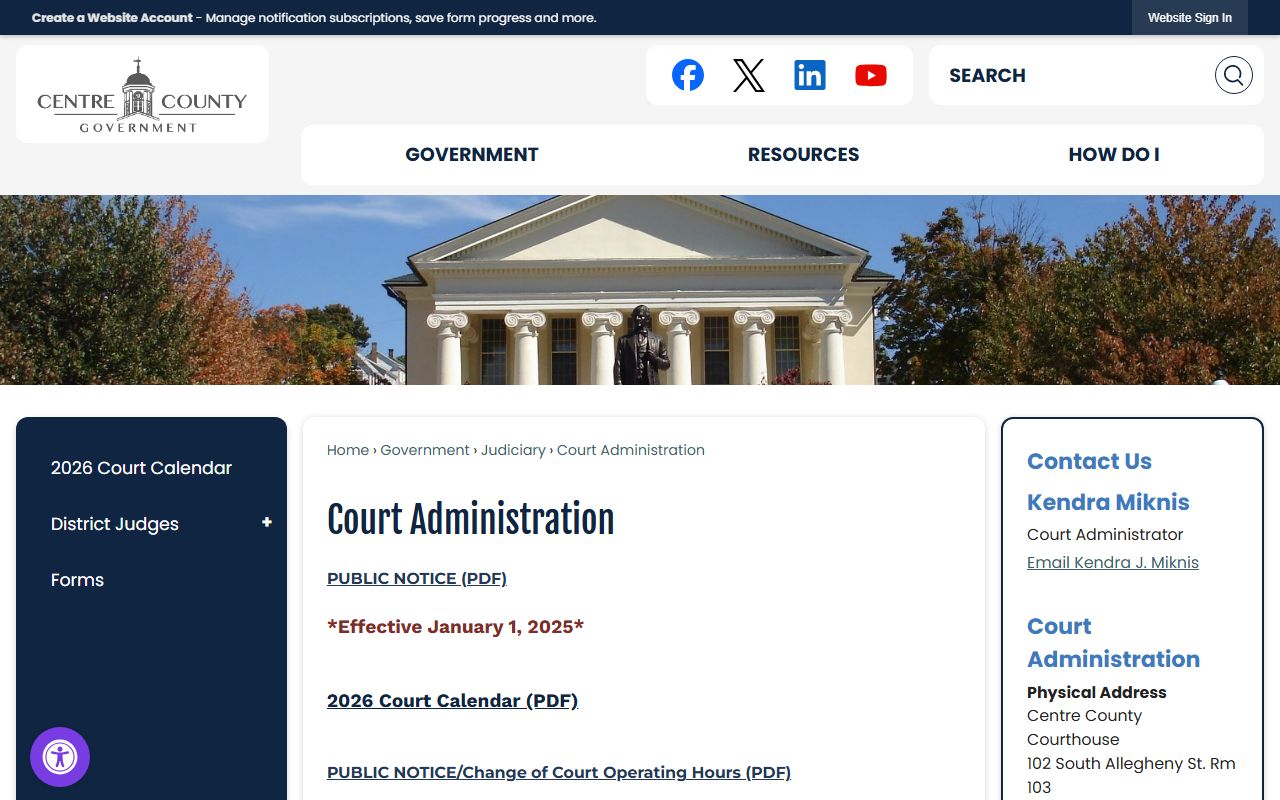
Court Administration is not a substitute for the filing offices, but it helps users identify which local court unit controls the hearing, courtroom service, or access rule they need.
Centre County Court Locations
The Court of Common Pleas is the county trial court, but Centre County court access also depends on the six Magisterial District Court offices. Those lower courts are not branches of a county court in the Texas sense. In Pennsylvania, they are the minor judiciary. They handle the front end of many criminal, traffic, landlord-tenant, and small civil matters before any Common Pleas filing exists.
| Court | Type | Address | Phone |
|---|---|---|---|
| Court of Common Pleas | General trial court | Centre County Courthouse, 102 South Allegheny Street, Bellefonte, PA 16823 | 814-355-6728 |
| 49-1-01 | Magisterial District Court | 131 South Fraser Street, State College, PA 16801 | 814-231-1420 |
| 49-2-01 | Magisterial District Court | 1524 West College Avenue, Box 11, State College, PA 16801 | 814-237-4981 |
| 49-3-02 | Magisterial District Court | 3555 Benner Pike, Suite C, Bellefonte, PA 16823 | 814-355-6739 |
| 49-3-03 | Magisterial District Court | 118 Enterprise Drive, Philipsburg, PA 16866 | 814-342-4557 |
| 49-3-04 | Magisterial District Court | 2795 Earlystown Road, Centre Hall, PA 16828 | 814-364-1492 |
| 49-3-05 | Magisterial District Court | 121 South Pugh Street, State College, PA 16801 | 814-861-7406 |
The county's District Judges page lists each Magisterial District Judge, office address, phone number, hours, and the boroughs, townships, or State College voting districts served. The county also publishes a Magisterial District Court Finder that lets a user enter an address and city to identify the correct office.
The county District Judges listing is shown here because it is often more useful than a courthouse-only address for traffic citations, summary offenses, and landlord-tenant claims.
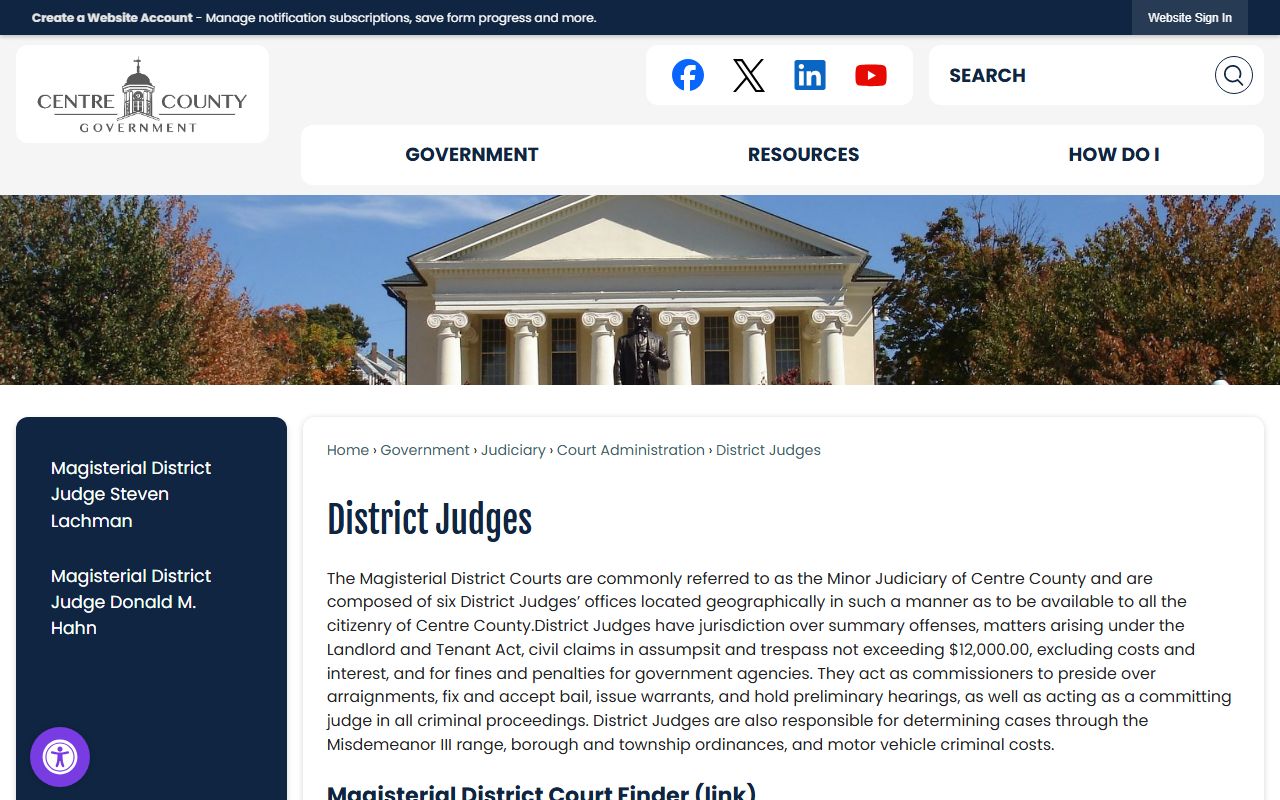
State College has more than one district office, while Bellefonte, Philipsburg, and Centre Hall offices cover other local communities. The citation, complaint, or hearing notice should control which office to contact.
Common Pleas vs Magisterial Courts
Pennsylvania does not use a separate county court layer for Centre County trial matters. The key split is between the Court of Common Pleas and Magisterial District Courts. Common Pleas is the trial court of general jurisdiction. Magisterial District Courts are lower courts with limited civil, criminal, traffic, and preliminary authority. Appeals from MDJ judgments and many agency decisions can move to Common Pleas.
| Topic | Court of Common Pleas | Magisterial District Courts | State/Appellate Courts |
|---|---|---|---|
| Civil scope | Major civil cases, judgments, equity, appeals, family matters, and claims beyond minor-court limits | Civil claims in assumpsit and trespass up to $12,000, excluding costs and interest, plus landlord-tenant matters | Appeals and statewide review, not trial filing for ordinary county cases |
| Criminal scope | Felony cases, higher misdemeanor dispositions, pleas, trials, sentencing, probation violations | Preliminary arraignments, bail, warrants, preliminary hearings, summary offenses, and cases through Misdemeanor III range | Superior Court handles many criminal appeals; Supreme Court review is discretionary in many matters |
| Traffic role | DUI and serious motor-vehicle cases after criminal filing or appeal | Most citations, summary traffic offenses, and motor-vehicle criminal costs | PennDOT driver records are separate from court traffic dockets |
| Record office | Prothonotary and Clerk of Courts, with many docket sheets also in UJS | MDJ office and UJS Case Search | Appellate docket systems and appellate court offices |
The Magisterial District Court Finder screenshot below shows why address-based routing matters. A user with a traffic citation, summary charge, or small civil claim may need a State College, Bellefonte, Philipsburg, or Centre Hall district office instead of the courthouse record counter.
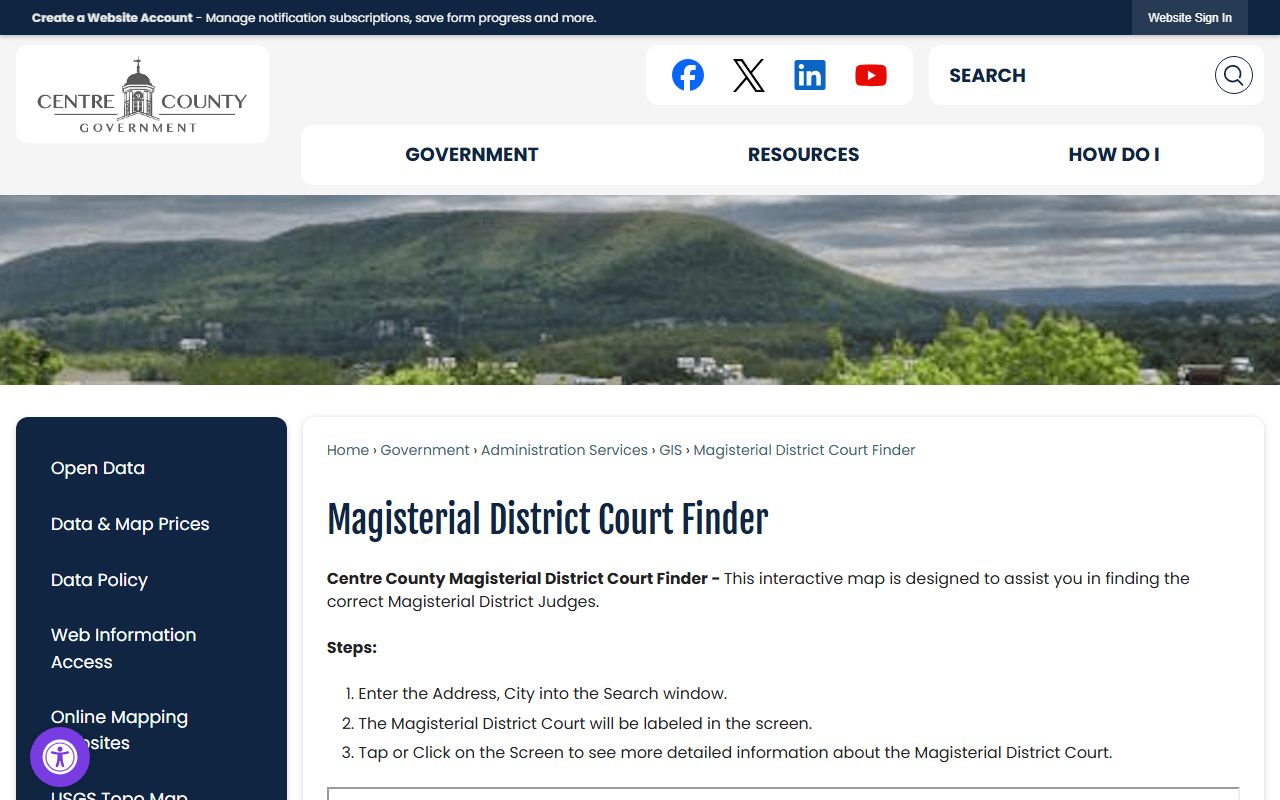
The finder is especially useful when the event occurred near a township line or in the Penn State and State College area, where more than one MDJ office may be nearby.
Centre County Case Flow
A Centre County criminal case may appear first as a Magisterial District Court docket. The MDJ handles preliminary arraignment, bail, and preliminary hearing events. If charges are held for court, the case moves to the Court of Common Pleas, where the District Attorney files the formal information, the defendant is arraigned, motions are filed, and the case ends by plea, trial, dismissal, or sentence.
Criminal flow: Complaint or arrest › Preliminary arraignment › Bail › Preliminary hearing › Information in Common Pleas › Arraignment › Motions › Plea or trial › Disposition › Sentencing › Appeal.
Civil cases can begin in a Magisterial District Court when the claim is within the minor-court limit, or in Common Pleas when the matter is larger or belongs to a specialized division. Divorce, custody, protection-from-abuse, many judgment matters, and larger civil claims are Common Pleas records. Estate and guardianship matters move through the Orphans' Court Division and the Register of Wills and Clerk of Orphans' Court.
Civil flow: Complaint or petition filed › Service › Response › Motions or conference › Hearing, arbitration, settlement, or trial › Order or judgment › Appeal when allowed.
Note: A UJS docket search may show the public event history, but certified copies must come from the office that holds the file.
Centre County Court Divisions
The Court of Common Pleas handles several record streams under one county trial-court umbrella. Civil filings include complaints, judgments, liens, mortgage foreclosure, quiet title, arbitration, landlord-tenant appeals, and other civil actions. Family filings include divorce, custody, child support through Domestic Relations, and protection-from-abuse proceedings. Criminal filings include informations, pleas, trial events, sentences, fines, restitution, warrants when publicly docketed, and probation-related entries.
The Orphans' Court Division handles estate and guardianship matters, while the Register of Wills and Clerk of Orphans' Court keeps the probate and marriage side of those records. Adoption records are filed there too, but they are not ordinary public records. That split is why a Centre County user looking for a divorce decree contacts the Prothonotary and Clerk of Courts, while a user looking for a marriage record or estate file contacts the office at Willowbank.
- Docket
- The chronological list of case events, filings, orders, hearings, and payment entries.
- Information
- The prosecutor's formal charging document after a criminal case reaches Common Pleas.
- Disposition
- The outcome of a case or charge, such as guilty plea, dismissal, acquittal, or sentence.
- Letters
- Probate documents that authorize a fiduciary to act for an estate.
Centre County Judicial District
The 49th Judicial District is a single-county judicial district for Centre County. Appeals from local cases generally move to the Superior Court of Pennsylvania for many criminal and civil matters or to Commonwealth Court for many government-agency matters. A later appeal may reach the Supreme Court of Pennsylvania when review is available. Federal cases are separate and go through the U.S. District Court for the Middle District of Pennsylvania rather than the county trial court.
The Pennsylvania judiciary's Centre County listing provides the Court of Common Pleas contact as 403 Centre County Courthouse, Bellefonte, PA 16823, phone 814-355-6728. Local Court Administration is in Room 103 at the courthouse, phone 814-355-6727, with posted office hours Monday through Friday from 8:00 a.m. to 4:00 p.m.
The Pennsylvania judiciary Centre County court listing is shown here because it confirms the statewide court-system view of the local court, not just the county office view.
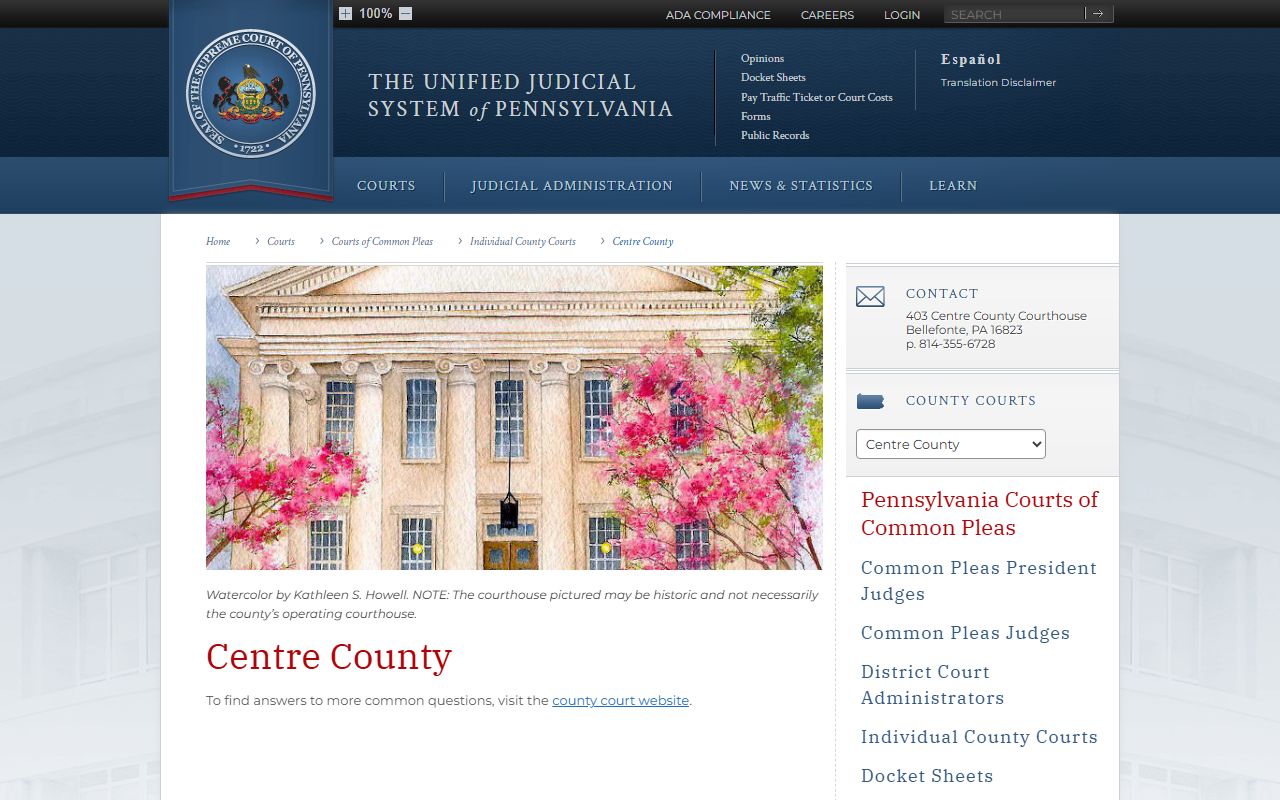
Use that listing for the official state-court identity, then use the county office pages for records, local forms, room numbers, and county-level service details.
Centre County Lower Courts
Centre County's Magisterial District Courts are important because they generate many records before Common Pleas is involved. They handle summary offenses, traffic citations, borough and township ordinances, landlord-tenant cases, small civil claims, fines and penalties for agencies, preliminary arraignments, bail, warrants, and preliminary hearings. They also handle cases through the Misdemeanor III range as described by the county's District Judges page.
A party with a citation or MDJ docket should search UJS Case Search by citation number, complaint number, participant name, docket number, or other identifier. The MDJ office can answer questions about hearing schedules, payment options, continuance requests, and local filing details. PAePay may accept payment for eligible traffic tickets, court costs, fines, or restitution, but not every matter can be paid online.
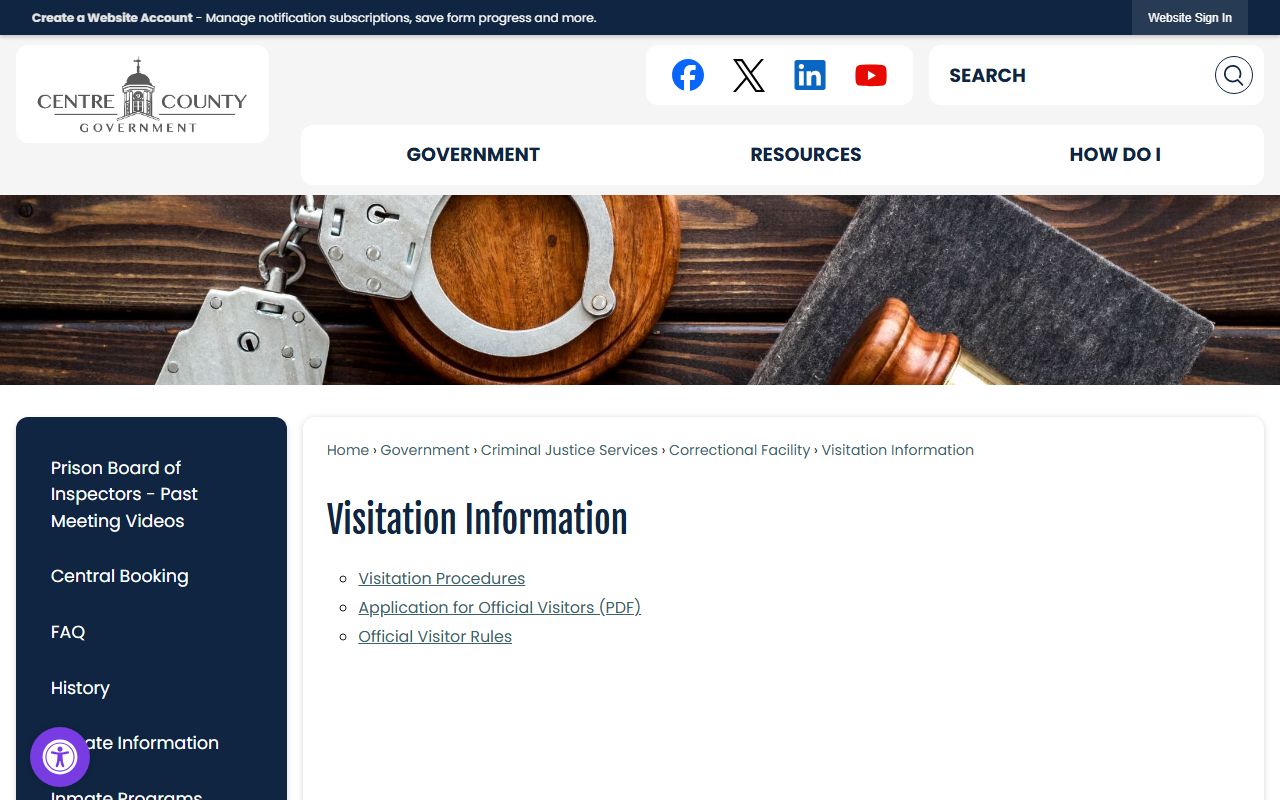
The county's visitation-procedure screenshot appears in the manifest for this trial-court page because court and custody processes often intersect after bail, sentencing, or transport events. Use jail visitation and central-booking materials only for custody logistics, not as a replacement for the issuing court's docket.
When the court record shows custody, detainer, bail, or sentencing events, confirm the court status through UJS or the clerk and the custody status through the jail or VINE.